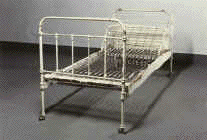
Bed from the Sachsenberg
psychiatric asylum
Courtesy of USHMM Photo Archives
The T4
Euthanasia Program was a Nazi German effort
--framed as a euthanasia program-- to kill
incurably ill, physically or mentally disabled,
emotionally distraught, and elderly people.
Adolf Hitler initiated this program in 1939,
and, while it was officially discontinued in
1941, killings continued covertly until the
military defeat of Nazi Germany in 1945.
In
October 1939, Adolf Hitler empowered his
personal physician and the chief of the
Chancellery of the Führer to kill people
considered unsuited to live. He backdated his
order to September 1, 1939, the day World War II
began, to give it the appearance of a wartime
measure. In this directive, Dr. Karl Brandt and
Chancellery chief Philipp Bouhler were "charged
with responsibility for expanding the authority
of physicians…so that patients considered
incurable, according to the best available human
judgment of their state of health, can be
granted a mercy killing."
Within
a few months, the T4 Program --named for the
Chancellery offices that directed it from the
Berlin address Tiergartenstrasse 4-- involved
virtually the entire German psychiatric
community. A new bureaucracy, headed by
physicians, was established with a mandate to
kill anyone deemed to have a "life unworthy of
living." Some physicians active in the study of
eugenics, who saw Nazism as "applied biology,"
enthusiastically endorsed this program. However,
the criteria for inclusion in this program were
not exclusively genetic, nor were they
necessarily based on infirmity. An important
criterion was economic. Nazi officials assigned
people to this program largely based on their
economic productivity. The Nazis referred to the
program's victims as "burdensome lives" and
"useless eaters."
The
program's directors ordered a survey of all
psychiatric institutions, hospitals, and homes
for chronically ill patients. At
Tiergartenstrasse 4, medical experts reviewed
forms sent by institutions throughout Germany
but did not examine patients or read their
medical records. Nevertheless, they had the
power to decide life or death.
While
the program's personnel killed people at first
by starvation and lethal injection, they later
chose asphyxiation by poison gas as the
preferred killing technique. Physicians oversaw
gassings in chambers disguised as showers, using
lethal gas provided by chemists. Program
administrators established gas chambers at six
killing centres in Germany and Austria:
Hartheim, Sonnenstein, Grafeneck, Bernburg,
Hadamar, and Brandenburg. The SS (Nazi
paramilitary corps) staff in charge of the
transports donned white coats to keep up the
charade of a medical procedure. Program staff
informed victims' families of the transfer to
the killing centres. Visits, however, were not
possible. The relatives then received condolence
letters, falsified death certificates signed by
physicians, and urns containing ashes.
A
few doctors protested. Some refused to fill out
the requisite forms. The Roman Catholic church,
which had not taken a stand on the "Jewish
question," protested the "mercy killings." Count
Clemens August von Galen, the bishop of Münster,
openly challenged the regime, arguing that it
was the duty of Christians to oppose the taking
of human life even if this cost them their own
lives.
The
transformation of physicians into killers took
time and required the appearance of scientific
justification. Soon after the Nazis came to
power, the Bavarian minister of health proposed
that psychopaths, the mentally retarded, and
other "inferior" people be isolated and killed.
"This policy has already been initiated at our
concentration camps," he noted. A year later,
authorities instructed mental institutions
throughout the Reich to "neglect" their patients
by withholding food and medical treatment.
Pseudoscientific
rationalizations for the killing of the
"unworthy" were bolstered by economic
considerations. According to bureaucratic
calculations, the state could put funds that
went to the care of criminals and the insane to
better use&emdash;for example, in loans to
newly married couples. Proponents for the
program saw incurably sick children as a burden
on the healthy body of the Volk, the German
people. "Wartime is the best time for the
elimination of the incurably ill," Hitler said.
The
murder of the handicapped was a precursor to the
Holocaust. The killing centres to which the
handicapped were transported were the
antecedents of the extermination camps, and
their organized transportation foreshadowed mass
deportation. Some of the physicians who became
specialists in the technology of cold-blooded
murder in the late 1930s later staffed the death
camps. They had long since lost all their moral,
professional, and ethical inhibitions.
Like
the Judenrat ("Jewish Council") leaders during
the Holocaust, psychiatrists were able to save
some patients during the T4 Program, at least
temporarily, but only if they cooperated in
sending others to their death. The handicapped
killing centres developed gas chambers like
those later used at extermination camps. As the
extermination camps did later, the handicapped
killing centres installed ovens to dispose of
dead bodies. The death camps that followed took
the technology to a new level. The extermination
camps could kill thousands at one time and burn
their bodies within hours.
On
August 24, 1941, almost two years after the T4
Program was initiated, it appeared to cease. In
fact, it had gone underground and continued
covertly during the war years. While the program
claimed over 70,000 victims during its two years
of open operation, the killing centres murdered
even more victims between the official
conclusion of the program and the fall of the
Nazi regime in 1945. The total number killed
under the T4 Program, including this covert
phase, may have reached 200,000 or more. The
official conclusion of the T4 Program in 1941
also coincided with the escalation of the
Holocaust, the culmination of Nazi programs to
eliminate those deemed an embarrassment to the
"master race."
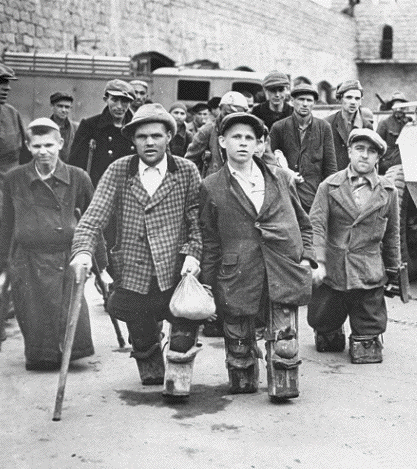
Survivors...
http://www.britannica.com/eb/article-9342909
